
Investing in a Gold IRA doesn’t have to be complicated, but it does require careful planning. How to invest in a Gold IRA in 2026 comes with process and research and this article will bring every piece of research and step that makes your Gold IRA Investing journey easy.
The process generally involves choosing a Gold IRA provider, opening a self-directed IRA with an appropriate Gold IRA custodian, funding the account through an eligible contribution, transfer, or rollover, selecting qualifying precious metals, and having those precious metals stored through the required custodial arrangement.
The most important thing is not to rush. Taking time to understand things can make the Gold IRA investing journey comfortable. Having a clear education on a Gold IRA can you make confident to put your real money in precious metals investing.
Compare Gold IRA companies, understand Gold IRA fees, verify the Gold IRA custodian and storage arrangements, check that your precious metals qualify under IRS rules, and understand the tax implications before moving retirement money.
Gold can be an interesting addition to a diversified retirement portfolio, but it is not a guaranteed investment and shouldn’t be treated as one.
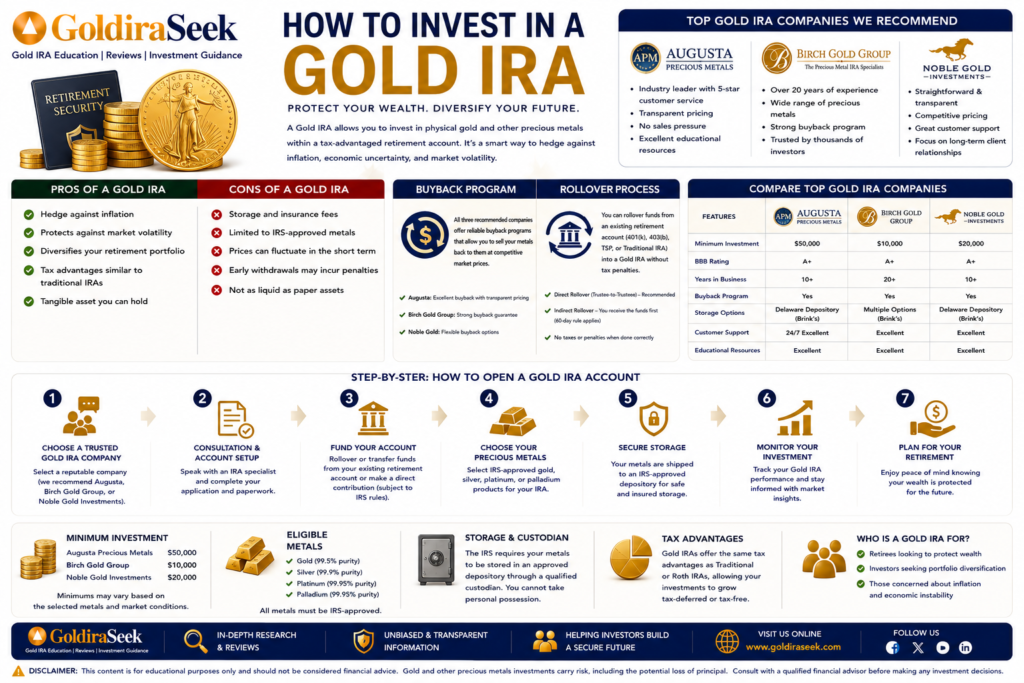
A good Gold IRA decision starts with education, with not a sales pitch.
If you have ever wondered how to invest in a Gold IRA for retirement, if not then you are not alone.
Gold has been used as a store of value for thousands of years, but buying a few gold coins and putting them in a safe is very different from investing in gold through a retirement account.
That’s where a Gold IRA comes in.
A Gold IRA allows eligible investors to hold certain physical precious metals inside an Individual Retirement Account while receiving the tax treatment associated with the type of IRA they use. However, the process isn’t as simple as walking into a gold dealer and buying a coin.
There are IRS rules to follow, an approved Gold IRA custodian to work with, eligible precious metals to select, and an approved storage arrangement for the metals.
This guide explains the entire process in simple language.
Whether you are completely new to precious metals or you are considering moving part of an existing 401(k) or IRA into physical gold, you will learn what a Gold IRA is, how it works, how to open one, how much does it cost, where the gold is stored, and what mistakes to avoid.
What Is a Gold IRA?
A Gold IRA is a self-directed Individual Retirement Account that can hold certain IRS-approved physical precious metals.
Traditional IRAs commonly hold investments such as stocks, bonds, and mutual funds. A self-directed IRA can provide access to a wider range of permitted investments, including certain precious metals.
But there’s an important detail:
You cannot put just any piece of gold into an IRA.
The IRS has specific rules regarding which precious metals qualify. Certain gold, silver, platinum, and palladium bullion can qualify if they meet the required standards and are held by the appropriate IRA trustee or custodian.
This is why a Gold IRA is different from simply buying gold personally.
How Does a Gold IRA Work?
Think of a Gold IRA as a retirement account with a different type of investment inside it. Instead of owning only traditional paper assets, the account can hold qualifying physical precious metals.
The basic process looks like this:
Choose a Gold IRA company, Open a self-directed IRA, Fund the account, Choose eligible precious metals, Custodian purchases the metals, Depository stores them, Manage the account for retirement
The Gold IRA company generally helps with the precious metals transaction and account-opening process.
The custodian administers the IRA. The depository stores the physical metals.
Keeping these roles separate is important because your retirement gold isn’t supposed to sit in your bedroom safe or under your mattress.
Who Can Invest in a Gold IRA?
A Gold IRA may be available to investors who are eligible to open or fund an IRA and who meet the requirements of the particular account and transaction.
People commonly consider Gold IRAs when they:
- Have an existing traditional IRA
- Have an eligible former-employer 401(k)
- Want to diversify retirement assets
- Are interested in physical gold
- Are approaching retirement
- Want exposure to precious metals
However, eligibility and tax consequences can vary depending on the type of retirement account and the transaction.
That’s why it’s important to distinguish between a Gold IRA rollover, an IRA transfer, and a new contribution.
How to Invest In a Gold IRA
Now let’s get to the question you are probably here for:
How do you actually invest in a Gold IRA?
Here’s the complete process of investing in a Gold IRA.
Step 1: Decide Why You Want Gold
Before searching for a Gold IRA company, decide why you want physical gold or other precious metals in your retirement portfolio.
Are you looking for:
- Diversification?
- Long-term exposure to gold?
- A hedge against inflation?
- Physical ownership through a retirement account?
- An alternative to stock market?
This step is more important than it sounds. You shouldn’t open a Gold IRA simply because gold has recently gone up. Gold can fall in value too. A retirement portfolio should be built around your long-term goals, not yesterday’s headlines. long-term can give you best results but there is no guruntee at all.
Step 2: Choose a Gold IRA Company
Once you understand why you want a Gold IRA, compare different Gold IRA companies. Don’t choose a company simply because its advertisement says it’s the “best.”
Always compare these things before choosing any Gold IRA company.
- Reputation
- Transparency
- Fees
- Minimum investment
- Customer service
- Educational resources
- Precious metals selection
- Gold IRA custodian
- Gold IRA storage
- Buyback program
This is where our best Gold IRA companies research can help you.
For example, a company with a low minimum investment might look attractive to a beginner, while another company with a higher minimum may provide a more education-focused experience.
There is no single Gold IRA provider that’s automatically best for every investor.
Step 3: Choose an IRS-Approved Custodian
A Gold IRA custodian is the financial institution responsible for administering your retirement account.
The custodian typically handles:
- Account administration
- Recordkeeping
- Transactions
- Required reporting
- Retirement account paperwork
- Coordination with the precious metals dealer
- Coordination with the storage facility
This is one of the most important parts of the process. You shouldn’t assume the company selling you gold is also the custodian. In many cases, they are separate businesses.
Step 4: Fund Your Gold IRA
After establishing the account, you need to fund it.
Depending on your circumstances, this may involve:
- A new IRA contribution
- An IRA transfer
- A 401(k) rollover to Gold IRA
- A rollover from another eligible retirement plan
For 2026, the IRS says the annual IRA contribution limit is $7,500, with a $1,100 catch-up contribution for individuals age 50 and older. These limits apply to IRA contributions generally and are separate from the mechanics of a rollover or transfer.
That’s an important distinction.
A rollover isn’t the same thing as making a new annual IRA contribution.
Step 5: Select Your Gold
Once your account is funded, you can choose qualifying precious metals.
The IRS does not allow an IRA to purchase every collectible coin or piece of precious metal.
Certain gold, silver, platinum, and palladium bullion can qualify when they meet the applicable requirements. Certain U.S. coins are also specifically allowed under the tax rules.
This is why investors should ask:
“Is this particular gold product IRA eligible?”
Don’t assume that because something is made of gold, it automatically qualifies.
Step 6: The Custodian Purchases the Metals
Once you’ve selected the products, the transaction is generally handled through the IRA custodian.
The custodian helps ensure that the purchase is made for the retirement account rather than treating the metals as your personal property.
This distinction is critical.
You don’t simply pay the dealer from your personal checking account and then call the coins part of your IRA.
The transaction needs to be structured correctly.
Step 7: Store the Gold in an Approved Facility
This is one of the biggest differences between a Gold IRA and personally owning gold.
You generally cannot simply take IRA-owned gold home and put it in your personal safe.
The IRS rules require qualifying bullion to be in the physical possession of the IRA trustee or custodian under the applicable rules.
That’s why Gold IRA providers work with professional precious metals depositories.
These facilities are designed specifically to store precious metals and typically provide security, inventory controls, and insurance.

How Much Money Do You Need to Invest In a Gold IRA?
There is no universal minimum investment established by the IRS for opening a Gold IRA.
Instead, individual companies can set their own minimum purchase requirements. That’s why you will see major differences among providers. Some companies may accept relatively small accounts, while others target investors rolling over tens of thousands of dollars.
This is one reason you should compare Gold IRA minimum investment requirements before choosing a provider.
A $50,000 minimum may be reasonable for one investor and completely unsuitable for another investor.
Gold IRA Fees
A Gold IRA isn’t free. Investors may encounter several types of expenses, including:
Account Setup Fee
Some custodians charge a one-time fee to establish the Gold IRA account.
Annual Custodian Fee
The custodian may charge an annual administration or maintenance fee.
Storage Fee
The depository charges for storing and safeguarding the physical precious metals.
Dealer Premium
Gold and silver products are generally sold above the underlying spot price. The difference can represent a dealer premium or spread.
Transaction Fees
Depending on the provider, investors may encounter charges for certain purchases, sales, wires, shipping, or other services.
Because fee structures vary significantly, investors should request a complete written fee schedule before moving retirement money.
For a deeper explanation, see our Gold IRA fees guide.
Can You Store a Gold IRA at Home?
This is one of the biggest myths surrounding precious metals retirement accounts.
You generally cannot treat IRA-owned gold as your personal home-stored gold.
The IRS has specific requirements for precious metals held by an IRA, including custody and possession rules.
So if someone tells you:
“Just create an LLC, buy the gold through your IRA, and keep it in your house.”
Don’t assume that strategy is automatically legal.
Transactions involving personal use or improper control of IRA assets can create serious tax consequences. The IRS specifically identifies prohibited transactions involving the improper use of IRA assets.
Gold IRA Storage
Once the metals are purchased, they are held through the approved custodial arrangement and stored at a professional depository.
There are generally two storage concepts investors may encounter:
Segregated Storage
Your metals are stored separately from those belonging to other customers.
Commingled or Non-Segregated Storage
Metals are stored together with similar assets while ownership records identify each investor’s holdings.
The exact storage options and fees depend on the custodian and depository
Gold IRA Pros and Cons
Before opening an account, understand both sides.
The goal isn’t to convince you that Gold IRAs are automatically good or bad.
The goal is to help you understand what you’re actually buying.
Common Gold IRA Mistakes to Avoid
Mistake 1: Choosing a Company Only Because It Has the Lowest Fees
A low fee doesn’t necessarily mean better value.
Look at the complete cost structure and the quality of service.
Mistake 2: Ignoring the Gold Premium
The spot price of gold isn’t necessarily the price you’ll pay for a physical coin or bar.
Always ask about the premium or spread.
Mistake 3: Buying Non-Eligible Metals
Not every gold coin qualifies for an IRA.
Verify eligibility before purchasing.
Mistake 4: Keeping IRA Gold at Home
Don’t assume home storage is automatically allowed.
Follow the applicable IRS custody requirements.
Mistake 5: Rolling Over Retirement Money Without Understanding the Transaction
A rollover can have tax consequences if handled incorrectly.
Understand whether you’re completing a direct transfer, rollover, or another type of transaction before moving your money.
Mistake 6: Putting Too Much of Your Retirement Portfolio Into Gold
Gold can be useful for diversification, but concentration creates its own risks.
Don’t let a salesperson decide your asset allocation for you.
Is a Gold IRA Right for You?
A Gold IRA may make sense for someone who wants physical precious metals to play a role in a diversified retirement strategy.
It may be less appropriate for someone who:
- Wants only low-cost stock-market exposure
- Needs frequent trading
- Wants dividend income from their investment
- Has a very small retirement balance
- Doesn’t want to pay storage and custodial fees
There is no universal answer.
The right question isn’t:
“Is gold good?”
The better question is:
“Does owning some qualifying physical precious metals inside a retirement account make sense for my personal financial plan?”
That’s a much more useful way to think about it.
How to Compare Gold IRA Fees
Don’t ask a Gold IRA company only:
“What’s your annual fee?”
Instead, ask for the total cost of ownership.
Before opening an account, ask:
- Is there an account setup fee?
- What is the annual custodian fee?
- What is the storage fee?
- Is storage segregated or commingled?
- Are there transaction fees?
- What premium am I paying over spot?
- Is there a minimum purchase?
- Are there shipping or wire fees?
- How does the buyback price work?
This gives you a much better picture of what the investment may actually cost.
For a deeper breakdown, see our Gold IRA fees guide.
Why Do You Need a Custodian?
An IRA isn’t the same thing as a normal brokerage account where you can simply buy something and keep it wherever you want.
The tax-advantaged structure comes with rules.
For precious metals, the IRS has specific requirements concerning qualifying assets and custody. Certain precious metals must be held by the IRA trustee or custodian rather than personally possessed by the account owner.
That’s why choosing an experienced custodian matters.
How to Choose a Gold IRA Custodian
When comparing custodians, look at:
Experience
How long have they administered self-directed retirement accounts?
Fees
What are the setup, annual administration, transaction, and other charges?
Customer Service
Can you reach someone when you have a question?
Reporting
Does the custodian handle required IRA reporting and documentation?
Precious Metals Experience
Does the custodian regularly administer precious metals IRAs?
Storage Relationships
Which approved depositories does the custodian work with?
Don’t choose a custodian simply because a Gold IRA salesperson recommends one.
Do your own research.
Where Is Gold Stored in a Gold IRA?
This is one of the most frequently misunderstood parts of precious metals investing.
When you purchase gold through a properly structured Gold IRA, you generally don’t take the metal home.
Instead, the metals are held through the required custodial arrangement and stored with an approved precious metals depository.
These facilities are designed specifically for precious metals.
They typically use:
- High-security vaults
- Controlled access
- Inventory systems
- Surveillance
- Insurance
- Auditing procedures
The exact arrangements vary by custodian and depository.
How Does a 401(k) Gold IRA Rollover Work?
A 401(k) rollover to Gold IRA is one of the most common ways people fund a precious metals retirement account.
Imagine you’ve left an employer and have $100,000 sitting in an old 401(k).
Instead of leaving the money there, you may be able to roll eligible funds into a self-directed IRA.
The general process is:
Old retirement plan → New self-directed IRA → Purchase eligible precious metals → Approved storage
However, eligibility depends on the retirement plan and your circumstances.
A current employer’s 401(k), for example, may have different rollover rules from an old employer’s plan.
Direct vs. Indirect Rollover
This distinction is important.
Direct Rollover
The money moves directly from the old retirement plan to the new retirement account.
Because you don’t personally receive the funds, this can help avoid some of the problems associated with an indirect rollover.
Indirect Rollover
The retirement funds are paid to you first, and you then have to complete the rollover within the applicable deadline.
This approach can create additional complications, including withholding and tax issues if the rules aren’t followed.
For that reason, many investors prefer to discuss a direct rollover with their existing plan administrator and new custodian.
How to Choose the Best Gold IRA Company
The phrase best Gold IRA companies gets searched thousands of times, but there’s no single company that’s perfect for everyone.
When comparing providers, look at these seven areas:
1. Reputation
How long has the company been operating?
2. Fees
Are the costs clearly explained?
3. Minimum Investment
Does the minimum fit your budget?
4. Customer Service
Can you get help when you need it?
5. Custodian
Who actually administers your IRA?
6. Storage
Where will your metals be stored?
7. Buyback
What happens when you want to sell?
A good Gold IRA provider should be able to answer these questions clearly.
Our Recommended Gold IRA Companies
At GoldIRASEEK, we evaluate providers using a consistent methodology rather than simply choosing the company offering the highest affiliate commission.
Some companies worth researching include:
Augusta Precious Metals
Augusta Precious metals is known best for its strong emphasis on investor education and personalized Gold IRA guidance.
Read our Augusta Precious Metals review to learn more.
Birch Gold Group
Birch Gold Group is a long-standing precious metals provider that offers gold, silver, platinum, and palladium options for eligible retirement accounts.
Noble Gold Investments
Noble gold Investments known for a relatively beginner-friendly approach and a broad selection of precious metals.
Lear Capital
Lear Capital is an established precious metals company offering Gold IRA services and direct precious metals purchases.
The “best” choice depends on your budget, goals, preferred metals, and the type of support you want.
What Should You Ask a Gold IRA Company Before Investing?
Before transferring your retirement savings, ask these questions:
1. What are all of your fees?
Don’t settle for “low fees.” Ask for the complete schedule.
2. Who is my custodian?
Get the custodian’s legal name.
3. Where will my gold be stored?
Ask for the name of the depository.
4. Is storage segregated or commingled?
Understand exactly what you’re paying for.
5. What is the minimum investment?
Make sure it fits your financial situation.
6. What products are IRA eligible?
Ask before purchasing.
7. How does your buyback program work?
Understand your potential exit.
8. What happens if I want to close the account?
Ask about liquidation, shipping, and other potential costs.
These questions can tell you a lot about how transparent a company really is.
Gold IRA Risks You Should Understand
A good Gold IRA guide shouldn’t only discuss the benefits.
There are real risks.
1. Gold Prices Can Fall
Gold isn’t guaranteed to increase.
If you purchase at a high price and the market falls, your investment can lose value.
2. Gold Doesn’t Generate Income
Unlike dividend-paying stocks or interest-bearing investments, physical gold doesn’t generate regular cash flow.
Your potential return primarily comes from changes in the value of the metal.
3. Fees Can Reduce Returns
A Gold IRA may involve:
- Custodian fees
- Storage fees
- Dealer premiums
- Transaction costs
Even if gold rises, these costs can reduce your overall return.
4. Physical Gold Has Buying and Selling Spreads
You may pay more when buying physical gold than its current spot price.
When selling, you may receive less than the retail price you originally paid.
That difference can make short-term trading particularly unattractive.
5. Regulatory Rules Matter
Gold held inside an IRA must satisfy applicable IRS requirements.
Buying an incorrect product or improperly taking possession of IRA assets can create tax complications.
Gold IRA Buyback Programs
Many Gold IRA companies advertise buyback programs.
This can sound reassuring, but investors should understand what “buyback” actually means.
Ask:
- Is the buyback price guaranteed?
- How is the price determined?
- Is it based on spot price?
- Is there a spread?
- Are there additional fees?
- How long does the transaction take?
A buyback program can make the selling process easier, but it doesn’t guarantee that you’ll receive the price you originally paid
A Quick Gold IRA Checklist
Before opening an account, make sure you’ve checked all of these:
- Understand why you want gold
- Compare Gold IRA companies
- Check minimum investment
- Review all fees
- Confirm the custodian
- Confirm the depositoryUnderstand storage
- Verify IRA-eligible metals
- Understand rollover rules
- Ask about the buyback process
- Consider your overall asset allocation
- Understand distribution rules
Speak with a qualified professional if you need tax or investment advice
If you can check every box, you’re in a much better position to make an informed decision.
Final Verdict: Is Investing in a Gold IRA Worth It?
A Gold IRA can be a useful retirement-investing option for the right investor.
It offers something traditional retirement accounts don’t necessarily provide: the ability to hold qualifying physical precious metals within a retirement account.
But that doesn’t make gold a perfect investment.
- There are fees.
- There are risks.
- Gold prices can fall.
- Physical gold doesn’t generate interest or dividends.
- And IRA rules must be followed carefully.
The smartest approach is therefore not to ask whether everyone should own gold.
Instead, ask whether a reasonable allocation to qualifying precious metals fits your own retirement strategy.
If the answer is yes, take your time and compare providers carefully.
- Look beyond advertisements.
- Understand the fees.
- Look beyond advertisements.
- Understand the fees.
- Check the custodian.
- Verify the storage facility.
- Confirm that your metals are eligible.
- Understand the rollover.
And know how you will eventually sell or take distributions.
That’s how you turn a Gold IRA from a confusing financial product into something you can actually understand.
Frequently Asked Questions
What is a Gold IRA?
A Gold IRA is a self-directed individual retirement account that can hold certain IRS-approved precious metals. Instead of investing only in traditional assets such as stocks and bonds, the account can hold qualifying physical gold and other precious metals under the applicable IRS rules.
The metals must be held through the proper IRA custodial arrangement rather than simply being kept at home.
How do I invest in a Gold IRA?
The basic process is:
- Research and compare Gold IRA companies
- Choose an appropriate IRA custodian.
- Open a self-directed IRA.
- Fund the account through an eligible contribution, transfer, or rollover.
- Select qualifying precious metals.
- Have the custodian arrange the purchase.
- Have the metals stored through the required depository arrangement.
The process sounds complicated at first, but a reputable provider and custodian should explain each step before you commit your retirement money.
Can I rollover my 401(k) into a Gold IRA?
In certain circumstances, yes.
A 401(k) to Gold IRA rollover may be possible, particularly when dealing with an eligible former-employer retirement plan.
However, current employer plans can have different rules.
Before moving the money, ask your plan administrator whether your 401(k) is eligible for a rollover and discuss the transaction with your new custodian.
Is a Gold IRA tax-free?
Not necessarily.
A Gold IRA is a tax-advantaged retirement account, but the tax treatment depends on the type of IRA.
Traditional IRA distributions are generally taxable under the applicable rules, while qualified Roth IRA distributions can receive different tax treatment.
Gold itself doesn’t make an investment tax-free.
Is a Gold IRA safe?
A Gold IRA isn’t risk-free.
There are several different types of risk:
- Gold price fluctuations
- Dealer premiums
- Selling spreads
- Custodian fees
- Storage costs
- Regulatory requirements
- Company-related risks
Professional depositories can provide security and insurance for stored metals, but that doesn’t guarantee the market value of your gold.
The safest approach is to understand the risks before investing rather than assuming gold is automatically safe.
What are the disadvantages of a Gold IRA?
Some of the biggest Gold IRA disadvantages include:
- Physical gold doesn’t pay dividends or interest.
- Prices can decline.
- Storage costs can reduce returns.
- Custodial fees can be higher than some traditional investment accounts.
- Physical gold can have buying and selling spreads.
- You must follow specific IRS rules.
- Some providers require relatively large minimum investments.
For these reasons, a Gold IRA isn’t necessarily appropriate for every retirement investor.
What are the advantages of a Gold IRA?
Potential benefits include:
- Portfolio diversification
- Exposure to physical precious metals
- Long history as a store of value
- Potential protection against certain economic risks
- Ability to hold qualifying physical metals within a tax-advantaged retirement structure
But benefits should always be considered alongside the risks and costs.
Can I store my Gold IRA at home?
You should not assume that you can simply take IRA-owned gold home and put it in a personal safe.
The IRS has specific rules regarding the custody and possession of precious metals held by an IRA. Qualifying metals generally need to be held through the appropriate trustee or custodian arrangement.
Be particularly cautious about advertisements promising an easy “home storage Gold IRA.”
If you’re considering such an arrangement, get independent tax advice before proceeding.
Where is Gold IRA stored?
Gold held in a properly structured IRA is generally stored through a professional precious metals depository under the required custodial arrangement.
A depository may offer:
- High-security vaults
- Surveillance
- Insurance
- Inventory controls
- Auditing
- Controlled access
Your custodian or Gold IRA company should tell you where your metals will be stored and what type of storage is being used.
What is a Gold IRA custodian?
A IRA custodian is the financial institution responsible for administering the IRA.
The custodian may handle:
- Account administration
- Recordkeeping
- Reporting
- Contributions
- Transfers
- Distributions
- Coordination of precious metals purchases
The custodian and precious metals dealer may be two different companies.
Always find out exactly who is responsible for your IRA.
What are the best Gold IRA companies?
The best Gold IRA companies are Augusta Precious Metals, Birch Gold Group and Noble Gold Investments

Dipendra Sah is the founder of GoldIRASeek where he researches and publishes educational content on Gold IRAs, precious metals, and retirement investing. He has 5 years of experience in the field of precious metals industry so his mission is to help readers to make informed decision through honest, well reserached, and easy to undersatnds guides.

